
This post contains simplified ideas inspired by those proposed in the book “Zen and the Art of Motorcycle Maintenance” (ZATAOMM). A tome I read a long, long time ago, and about which I now remember little, apart from the fact that it contains almost nothing about motorcycle maintenance and virtually nothing about Zen. There isn’t anything about Zen in this post either but, hopefully, there might be a sentence or two about Gravity Breaking.

Buckyball…
The first time I ever took part in one it was on a whim. I had heard of it as it was occasionally mentioned on Lave Radio and I wondered what the hell it was. About a year or so later, the beginning of the first Bucky – Magic 8 – Ball season started with Back to Pareco, a twist on the original Full Throttle at Pareco race. I took part, did badly, had a lot of fun and wrote about it in this – at the time – brand spanking new website.
From then on, I was hooked.

There have been 22 races since then. For most of those I struggled to understand how on Earth anyone could complete those courses so damed quickly and so I decided to do some research into the secret, magic Buckyballing methods the racing professionals rely on. How do they manage to supercruise to that station so quickly? How do they manage to get down to that surface installation that fast? Are they breaking the laws of supercruise? But no. There is a technique that I am only just now becoming to come to terms with. And it is not so much a technique, really, but an art.
The Art of Gravity Breaking!

The latest race in the 3310 Bucjyball season. Once Upon a Time in Leesti, is a rehash of an old Buckyballing old worlds rares run classic. Pick up rare goods in the old worlds of Leesti, Diso, Zaonce and Lave (four of the very first systems we saw in original Elite back in 1984), take them over a hundred odd light years away to sell. Buy more rare goods there and bring them back to Leesti to sell. Apparently this was the meta money maker for beginners back in the day. You could make tens of thousands of credits per trip! How times have changed!
Of course, as in all the previous Buckyball season races, there are two classes, but Raiko, the race sponsor, decided to do things a little differently this time. Instead of Regulation and Unlimited we had Once Upon a Time class, only using the regulation Cobra to stop at each station to buy and or sell the required rares, and a Shenanigan Class where any ship could be used but shenanigans were mandatory. I rather thought this was a nice touch!
The distances involved between the old worlds and the destination worlds were rather significant for a Buckyball race and so I needed a ship that could do this in as few jumps as possible, and so I opted for Xanadu, the Rushfleet’s Diamondback Explorer to do the scouting, bookmarking and plotting. Yet it was apparent that the DBX wasn’t really great at navigating all the intricate shenanigans we would need to perform. Cmdr. Ikaru Sulu announced that his dolphin could to the 114ly stretch in two jumps and so, unable to sleep one night, decided to engineer the Passage To Bangkok as a racer.

I took her out on the course and the difference to the I Think I’m Going Bald seemed vast. Whereas in the adder I was struggling to control my spiralling approaches to bodies in order to let their gravity break my speed enough to be able to drop out at the target station, in this newly engineered dolphin I was making these approaches far more accurately and consistently.
I swear I am never going to race in that bloody adder ever again!
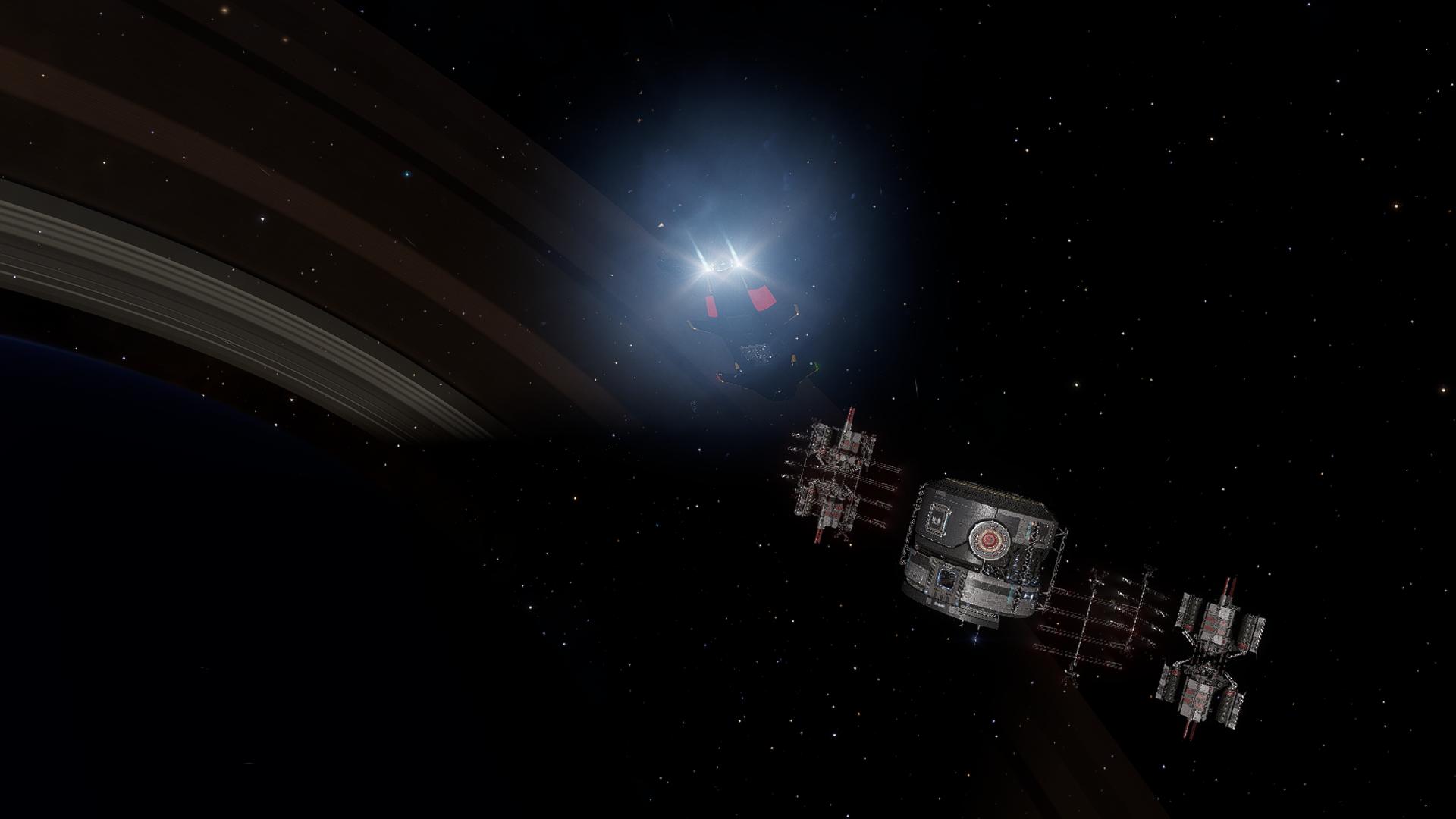
There are videos pertaining to Gravity Breaking on the BRC’s website. I watched them, digested them as best I could and tried it for myself. Over and over again I did everything Cmdr Ozric instructed but the body in question would just sail by like one of Douglas Adams’ deadlines. Even making the whooshing noise of which he was so fond. I just couldn’t get it. I did every step, like I was programmed by Ozric himself, but the task appeared impossible.
I used to practice it every now and again, sometimes during Buckyball run attempts, sometimes during normal game time, always failing. Until the Thargoid Structure Scramble race last year when, somehow, and not realising quite how I had done it, I managed to perform a successful spiral approach leading to a successful Gravity Breaking Manoeuvre and dropping perfectly in front of the station.
Now it was just a case of doing it again.
Since then I have had varying degrees of success but have had particular trouble this season, apart from the first race when we were all flying sidewinders. And, I have realised now that this was because of the ship I was mostly flying. And the reason I wasn’t doing well in an adder wasn’t for the reason that you might be thinking.
The problem with the adder is the off centre seating position and the view. I just can’t judge speed and distance correctly enough like that and find it far more comfortable in the dolphin. Sorry Adder fans!
Now, we are gong to do things a little differently for this particular post and I’m going to display the final results here…
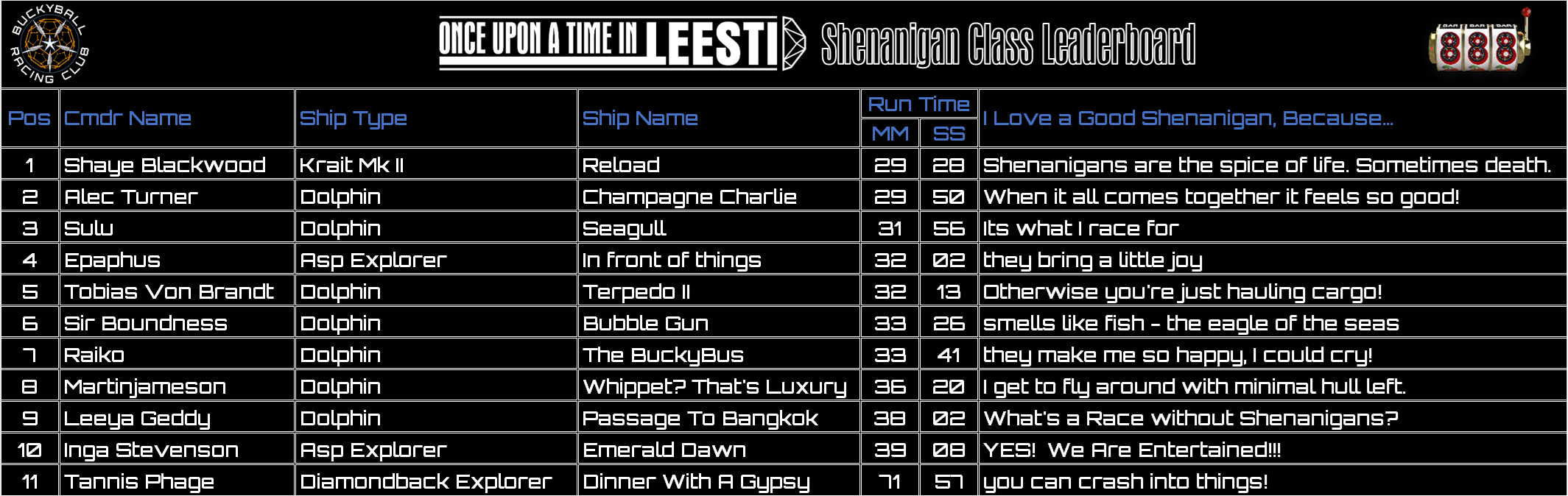
I sent requests out to the top three placed racers – Sulu, Alec and Shaye, to send two descriptions each of how they approached the gravity breaking for this race. All three reciprocated, with varying degrees of complexity and I shall go through them at intervals throughout this post.
Why two?
Well, ZATAOMM is partly an investigation as what constitutes Quality. What is Quality? Can you actually define it? Now, Robert M. Pirsig’s (the author) idea of Quality is rather different from what you or I might imagine it to be. Let’s simplify things greatly (I’m not articulate enough for any more than that I’m afraid) and put it in Elite Dangerous terms.
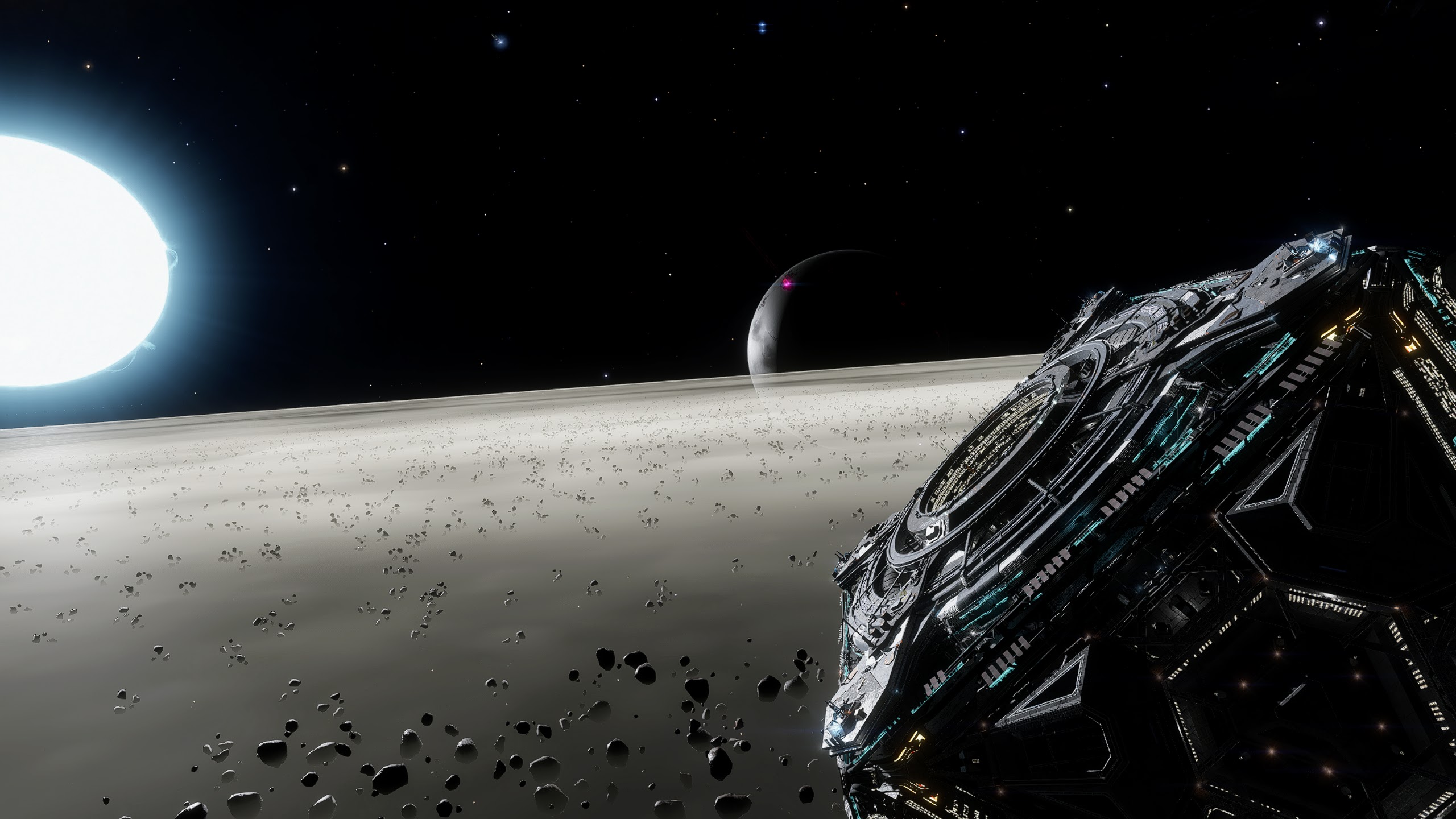
Imagine when we drop out of supercruise and are presented with a rotating coriolis station, the split millisecond before you recognise it as a coriolis, it’s just an indiscriminate, yet beautifully stunning object, that is what Pirsig identifies as Quality. He later splits Quality into two categories,
“Romantic” Quality and “Classic” Quality.
“Romantic” Quality is felt in the instant, to do with feelings, emotion and how it relates to “Classic” Quality which is multiple considerations over time – a loose example, I suppose, might be a set of instructions.
I would argue, then, a more “romantic” person describes how they play Elite with the emotions and wonder it gives them such as a role-player or a pirate/bounty hunter, explorer etc, whereas a “classic” player likes to fiddle around with its mechanics, pushes it to it’s boundaries, experiments, analyses everything the game can give them so they see what play can be squeezed out if it.
That is why two. And analysing what might constitute to be the Quality of Gravity Breaking is the reason for this post.

Shenanigan Class!
Now, what would a Buckyball race be without shenanigans? And the clever, wonderful bit about these shenanigans is – all of them are performed around the Old Worlds where we pick up our first five rare goods (we already pick up 2t of rares from Leesti before the start, then 1t from Lave, 1t from Zaonce and 1t from Diso). This means if we mess one of them up, it’s a teeny tiny jump back to the start. We could perform these in any order, of course, but it makes sense to do them after each of the rare pickups in order to keep the amount of jumps down to just three. Therefore, the first of these shenanigans would obviously be – flying through the tunnel at Associated Pharmaceutical Services at the starting system of Leesti, and then heading back around to fly through it again the same way as the first time.
I found the approach to this installation a little tricky. It’s in close orbit around a ringed gas giant so the standard spiral approach has to be used sparingly in order not to slow down too much. Getting the approach speed wrong was almost a given for me here and I would end up either performing a quick loop of shame as the drop point sailed past or I would be stuck too close to the gas giant crawling agonisingly slowly through supercriuse.
Studying the master racers’ videos afterwards I realised that I had neglected to continue my spiral approach even during, and after turning away from the gas giant to bear down on the target. This is a method I appear to have forgotten for all my approaches and is probably why my success in hitting the “dropzone” at an appropriate speed was so inconsistent.
Once the manoeuvre was completed it was onto Lave!
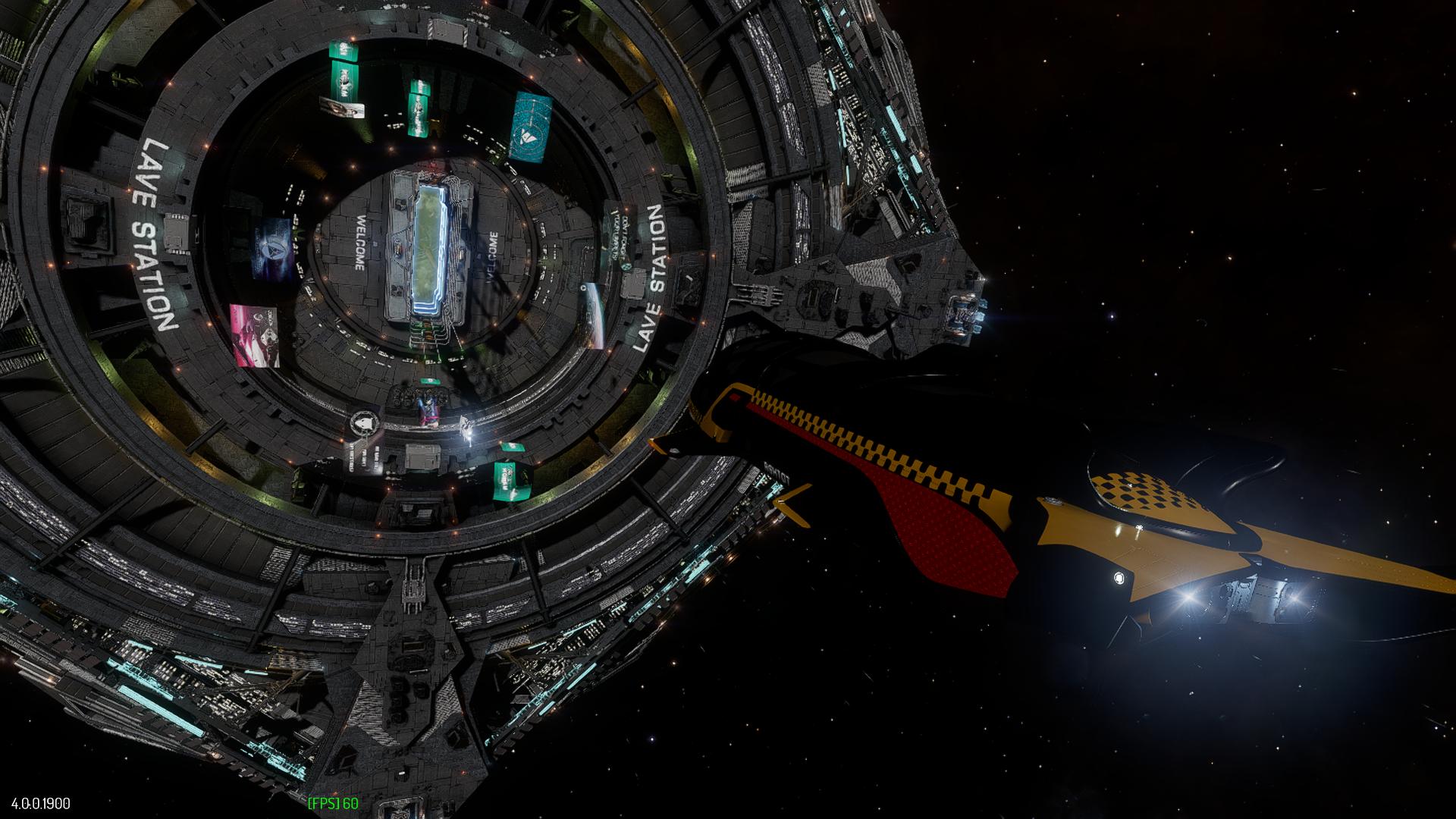
And so we come to the descriptions provided by the racer in third place – Cmdr. Ikaru Sulu.
“Accelerate away from the star using a shallow ellipse towards the body or station in question. Ignore the speed as it is not used for reference. Keep the ellipse until around 3 seconds away. Place the target in the upper left of the screen adjusting angle constantly to hold 3 seconds Keep this up until under 1 ls away and adjust speed to keep around 2 – 3 seconds away Drop out as soon as permitted.“
I gave a very loose definition to the racers of what constituted a “classic” description and a “romantic” description so we are definitely going to get some blurring between the definitions here, but Sulu gives a very concise, instruction leaflet style description, which is ideal. Now for the “romantic” –
“As above, as soon as I come out of Jump I target the system, usually to my left but far enough away to form an ellipse. As I get closer I place the target in my upper left corner and keep adjusting the angle with my stick. I try to hold 2 – 3 seconds whenever possible.
I gently use the throttle to maintain or reduce speed if it is wrong, but try not to if possible. Get this right and right to the point of drop out the throttle is virtually unused.
As you get closer the curve you need gets tighter and tighter. When the target is close enough I straighten up and start listening to the engines. Not sure I can word this well but the engine note changes as you near your target I at this point will align my ship for the slot using the local body for heavy deceleration if needed. Once the engine note has changed to what I can only describe as relaxed, I will ignore the seconds and watch the distance until the disengage blue comes on. If you are below 3 sends you need to be quick or you will overshoot. This happens of course. No point stressing, just loop around and go in again.All being well you will be in direct line of sight of the slot just over 8km out. Boost your way in as bravely as you dare.
For planetary landings the approach is much the same until you hit the planetary gravity well. The trick here is to get your angle right (I aim for 40deg) and the speed correct. The bar on the right side of the HUD tells you by going red if you are too fast. If it turns red then I pull up my nose a bit until it goes orange again. Get it right and you will transfer to approach mode which is speed controlled and come out under 7.5km to target. This is the area where I make most errors and so am always on alert.
Of course these descriptions do not cover the really fine adjustments and double braking using two bodies. I am no expert on explanations and will leave that to better qualified persons.
My first and foremost rule is watch and use your ears for this.“
Sulu gives us a wonderfully evocative narrative here, as he’s telling us the story of his approach technique through his eyes. I almost feel I’m his co-pilot as I’m reading this. I love that he seems so relaxed as he’s travelling throughout the manoeuvre, and I wonder if this might be a required attribute to complete it successfully. He also provides us with a planetary landing approach. These, I find, are even more satisfying to successfully attempt than an approach to an orbiting installation.
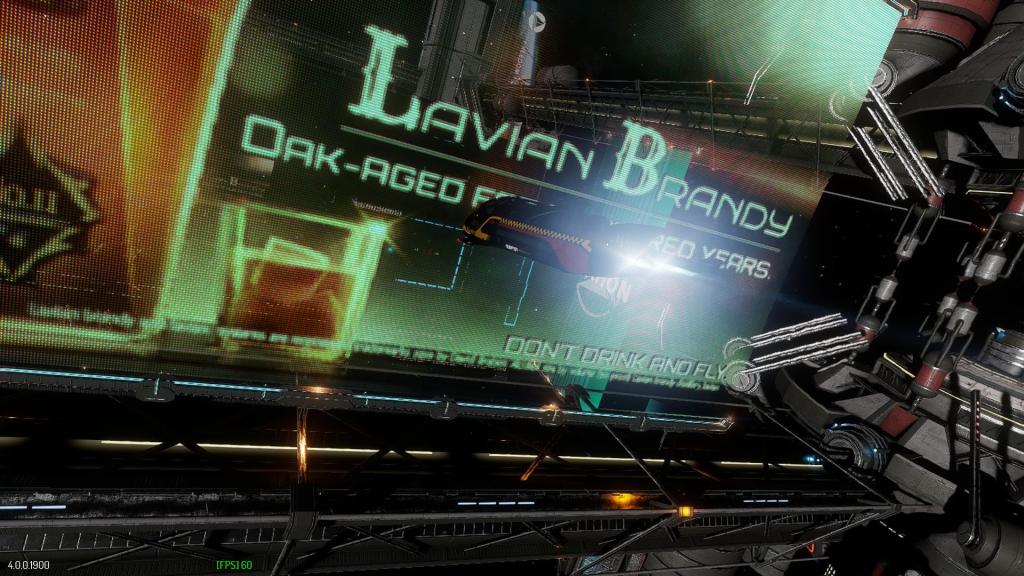
Once we’ve collected some Lavian Brandy from Lave Station, it’s just a tiny supercruise hop to the galaxy-wide famous Orange Sidewinder Bar. The home of the second (the first being The Archers, still going strong in 3310) longest running broadcast in the Galaxy – Lave Radio!
The approach here turned out to be rather straight forward. It’s just orbiting Lave at a much closer orbit than Lave Station. We just leave the station, enter supercruise and we’re there in seconds. We can use a little gravity breaking here but it only saves a few seconds or so. For most of my initial attempts I briefly engaged the SCO but this always resulted in an overshoot.
There are many holo-adverts here and we just have to fly through the three Lavian Brandy ads and one of the tall CQC Championship banners. The banners are on a cycle and we must only fly through when it’s displaying the CQC Championship.
Now it’s time to jump to Ridley Scott Station at Zaonce to pick up some Leathery Eggs.
Okay! Now it’s time for the racer in second place, Cmdr. Alec Turner. Now, Alec has pretty much gone the extra mile here with these submissions and I thank him heartily for them! He also created an instructional video a while back entitled, ahem, “Zen and the Art of Buckyball Racing” (pure co-incidence – honest guv) we can use as an accompaniment if we so wish. As before, we will start with his “classic” description.
“Full throttle away from star until speed is 1.5C then arc back around towards target avoiding intervening bodies. Keep full throttle until ETA is around 0:05. Apply full pitch up and use roll and yaw to spiral in towards target. Observe position of mailslot on HUD hologram and follow a course that comes in towards it going past the parent body. If ETA starts to climb above 0:04 then reduce amplitude of spiral, if it keeps dropping then increase it. Aim to fly close by parent at 0:03 such that speed drops back to around 0:05 as you come within final 0.1Ls, adjust throttle to 0:03 ETA for final 5Mm then full throttle to the station’s safe SC disengagement point at 1Mm“
If you want a complete breakdown of a Buckyball approach to a station orbiting a body, this is pretty much it in a nutshell. Well, coconut shell anyway. Let’s see what he has to say for his “romantic”
“Turn your back on the star and accelerate away until you’re travelling several times the speed of light, then arc back around towards your destination giving the orbit lines indicating possible gravity wells along your path a wide berth. Try to spot the station’s mailslot via the HUD hologram on your way in and maintain full throttle until the ETA drops to 0:04 or less depending on the supercruise agility of your ship. Now pull back hard on the stick and throw your ship into a big corkscrew using roll and yaw to steer while trying to focus on two things:
1) Keep an eye on your ETA while listening to the sound of your engines which should maintain a nice steady warble. If the warble starts rising in pitch towards a wail then it’s a sure sign that you’re accelerating and that the ETA will begin falling so you should pull into a tighter loop and/or reduce the throttle in order to wrestle that runaway horse back under control. Conversely, if the warble starts to sound too leisurely then you can probably push harder lest that ETA begin to climb again. NEVER let it go back above 0:06 if you have any Buckyball pride.
2) Once you’ve spotted the mailslot mentally plot a big looping course onwards from your current spiral which gracefully arcs around the back of the planet and in towards that toast rack. Follow that course and in the final moments as you’re approaching the planet from the back, straighten up, push the throttle hard and let your ship wail past the edge of the planet’s exclusion zone with the ETA dropping towards 0:02. Have faith that the gravity well is there (while using experience to gauge its strength) and that when you try to cut though it you’ll experience rapid deceleration in the final tenths of a light second that will bring you back towards a nice controlled 0:03 ETA at the last minute just as you hit the safe supercruise disengagement point.”
Alec has mixed both “romantic” description here with the sounds the engines are making and the pride a racer must have to never be travelling too slowly, with a “classic” structure, similar to his first instruction but with more intricate detail. I get the feeling Alec is more of a “classic” Elite Dangerous player! And, with his marvellous tutorial this all brings us closer to the Quality of a solid Gravity Breaking manoeuvre!
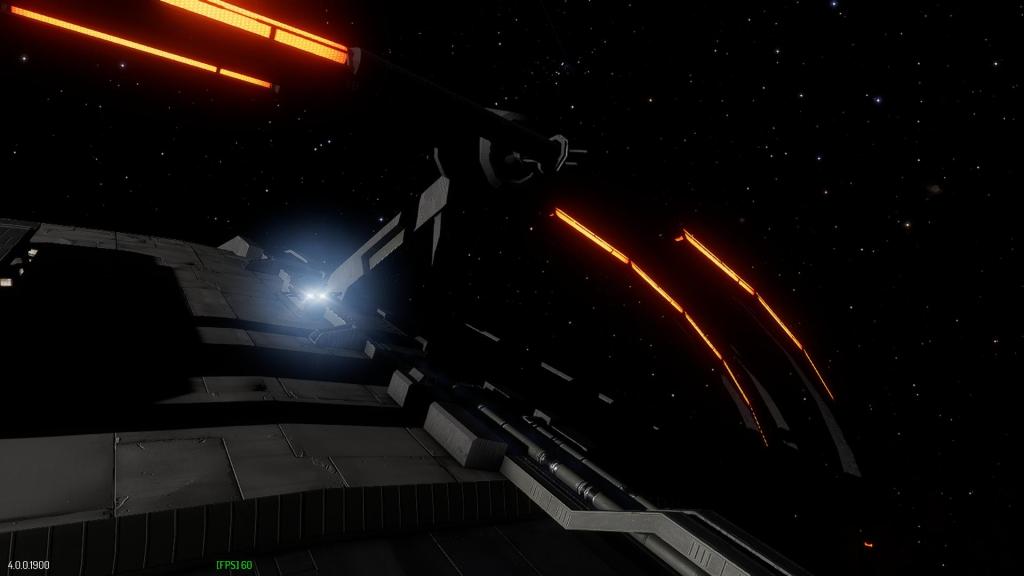
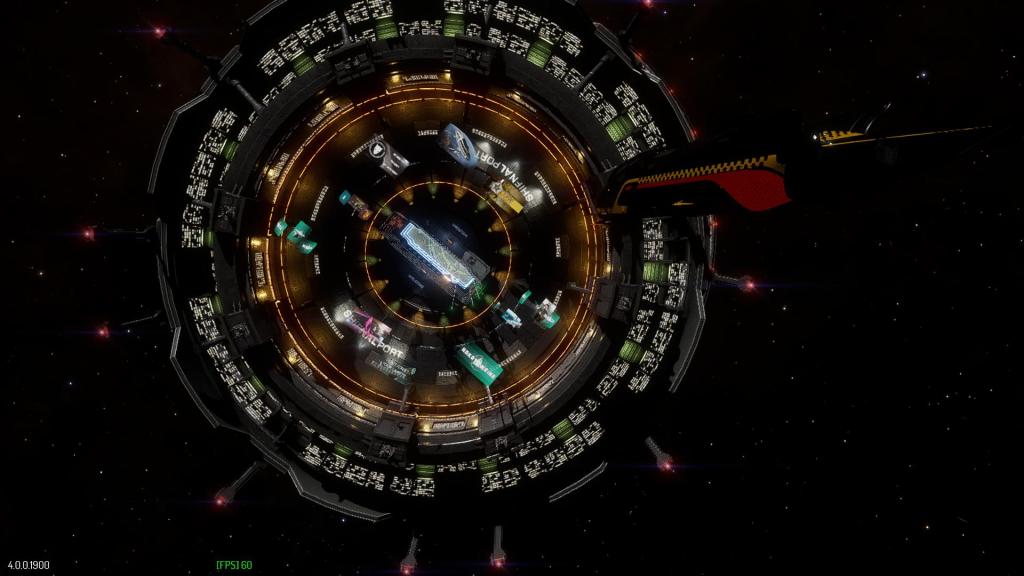
The last shenanigan. I like this one! The shenanigan isn’t only in the same system as the station the shenanigan is the station!
A small SCO boost from the star until your speed is at 25-30c before shutting it off and gliding in supercruise straight into a 3sec eta spiral. Absolutely joyous whenever you pull this off!
Then, once you’re here we need to request docking permission before performing one of my very favourite Buckyball shenanigans! Into the slot, flight assist off, spin around back towards the slot and boost out, fly as fast as possible under the orange hoops and around the back of the station, passing again under both orange hoops before re-entering the mailslot and docking.
Just try it! For fun! Go on! It’s exhilarating!
Now it’s a jump to the our final Old World system – Diso, to pick up some Diso Ma Corn from Shifnal Part and onto Diso 6f to hack into the Lave Radio signal booster and “upload our shenanigans to the galaxy”!
It’s time to hear from the Master. One of the greatest Buckballers of all time. A living Legend. The Racing Wizard Himself –
Shaye Blackwood!
The amount of races where Shaye has finished in the number one spot way, way faster than anyone else are uncountable. Well, if I looked back over every Buckyball race result Shaye has raced in they probably are countable but, in the last three seasons Shaye has won the vast majority of them. His race videos seem effortless, calculated, and with perfectly executed manoeuvres. I’ll have to warn you, though, I didn’t get much out of Shaye. I didn’t get a “classic” description as such and what I did get I think I shall class as a “romantic” description.
I don’t think I can describe an approach with or without gravity braking in a few sentences, there’s just too many variables. I can try for the concept –
“The art of arriving at your destination fast in supercruise is to utilise your ship’s maximum turn rate to keep almost overshooting until you are close enough to line up your drop out point. The tools to do this is the throttle, and any nearby gravity wells.”
I read this and I smiled. Disappointed? Don’t be! Think of something you do and do really well. Like running, driving, horse riding, flying maybe? Anything! Now try and break that down into lots of little steps.
Difficult isn’t it?
And the risk is, once you analyse so meticulously what you do so naturally into all those little steps, it might just throw one of them off balance. Shaye has moved on from any “classic” method and races fundamentally as a “romantic”. He has raised Buckyball Racing into an artform. His approaches are the ultimate representation of all parts that makes up the Art of Gravity Breaking and gels them all into a seamless, flawless whole. If you really want to see the Zen of Gravity Breaking, all you need to do is watch Shaye Blackwood in action. And, just to remind everyone, he did this in a Krait Mk II!
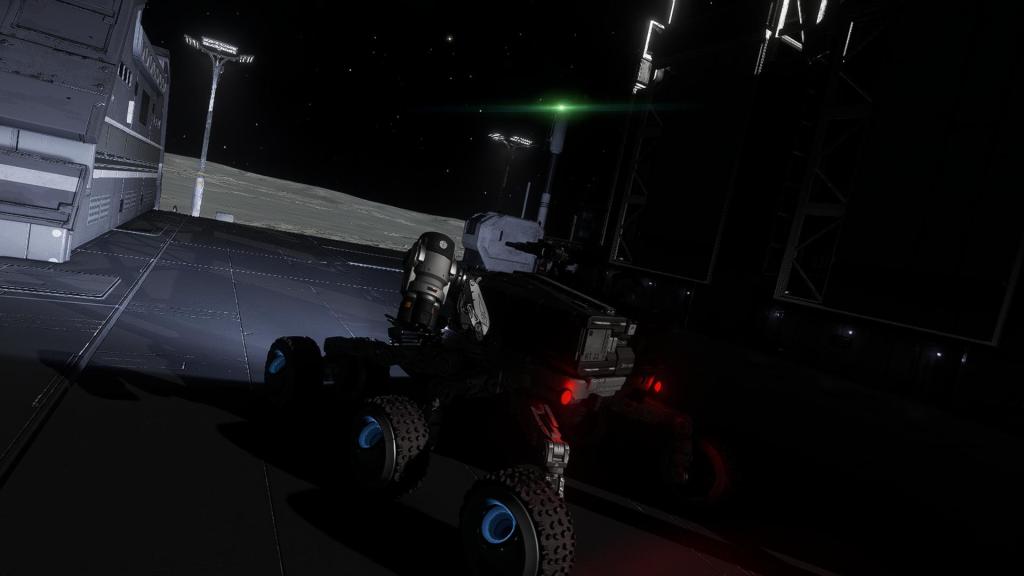
We have picked up our Diso Ma Corn, and now its time for the only surface installation approach of the race. Strangely, even though I generally struggle a lot more with surface target approaches I was a lot more successful with this than my orbiting body approaches. My main trouble is trying to enter orbital flight at the correct angle to the target, I’m a bit too cautious and it’s usually still just over the horizon. But I’m sure I’ll get there!
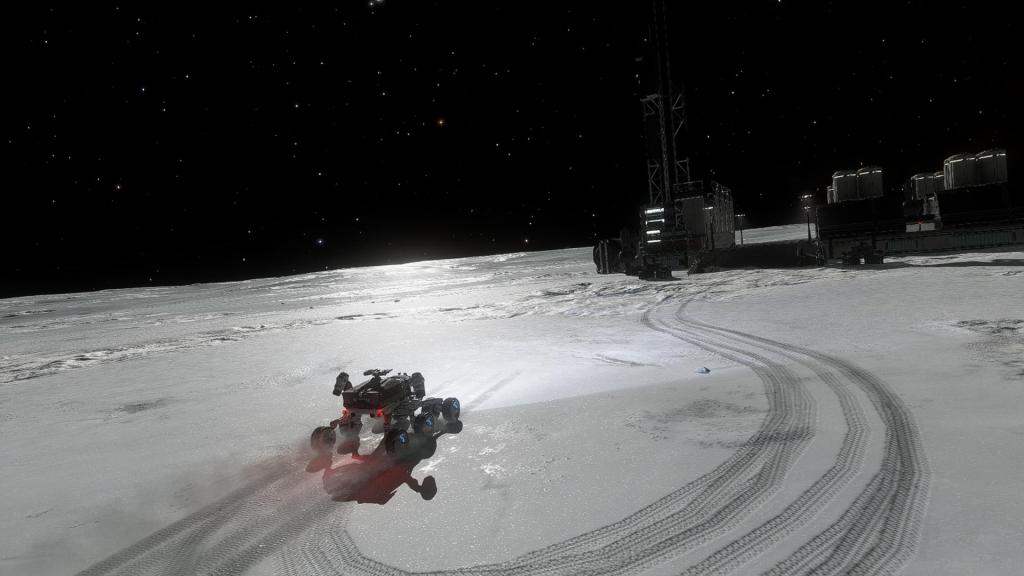
Then it’s just the simple task of flyving in a straight line, toward the target once the ship has landed just outside the trespass zone. During my last successful submission my flyving was terrible, bouncing all over the place, flyving sideways..
It was messy, but still a bit faster than driving and then after the data points have been scanned flyving away again and recalling the ship. Frustratingly enough on one of my final attempts my flyving was really, really good. And I logged my fastest time of that section by far, but my approach was interrupted briefly by an interdiction which messed up my angle to the target making it take an age to get down to the surface.
Now the easy parts! Fly the 114ly or so to Epsilon Indi to sell our five rares at Mansfield Orbital, then buy a ton of Indi Bourbon.

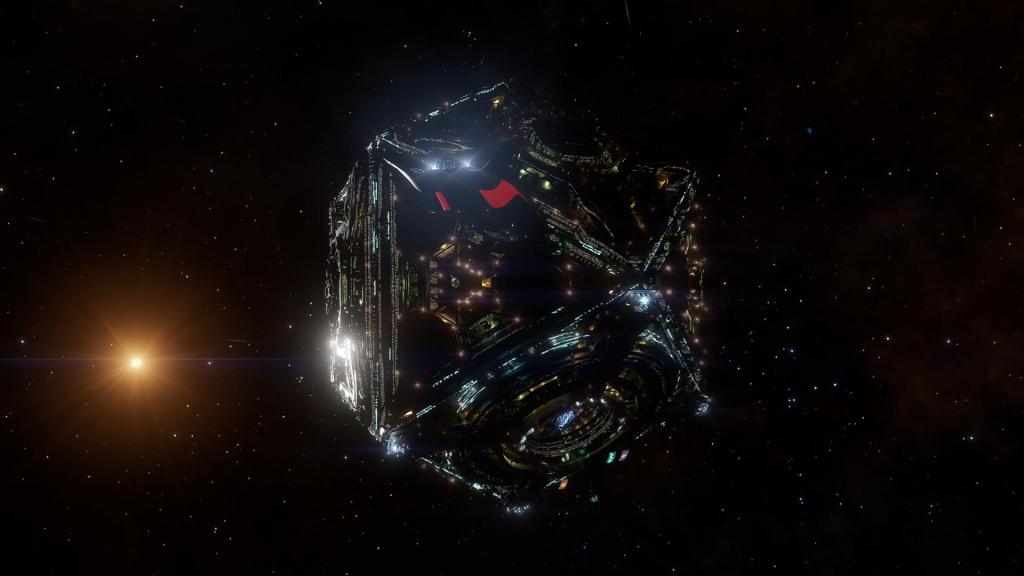
Our penultimate stop is Azeban City in Eranin where we need to buy 1t of Eranin Pearl Whiskey and then it’s just a matter of flying the 119ly or so back to Leesti and the finish! We can sell those two rares at our leisure. But make sure it’s before the next run!
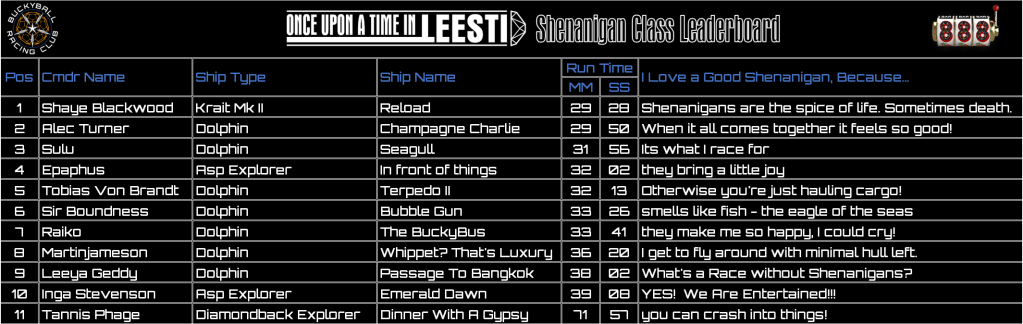
So! Have we made it any closer to understanding exactly what we need to do to nail a successful Gravity Breaking approach? Are we closer to understanding its Quality? I think we’ve got as close as we possibly could get, thanks to the wonderful contributions from Sulu, Alec and Shaye. The only way to make it any closer is to get out there and practice! And, as a further aid to us all, Alec has done a marvellous four-way split video of how the top four racers competed!
A massive thanks to Raiko! Such a beautifully designed race! I enjoyed it immensely! And a huge congratulations to everyone who took part, It was a tad unfortunate the race was punctuated with the arrival of the Ascendancy update. There were many extended Braben Tunnels during jumps not to mention the server outages that plagued the race for a few days, hampering everyone’s efforts. As trading rares have become the go-to method of earning merits it seems the whole player base were jumping around the old worlds. And probably still are!
Only one more race to go this season. Look out for it in the discord as it might be announced any day soon! Keep practicing, and fly like you don’t care!
Until next time, racers! o7
 Elite Dangerous RUSH FLEET
One thought on “Zen and the Art of Gravity Braking”